
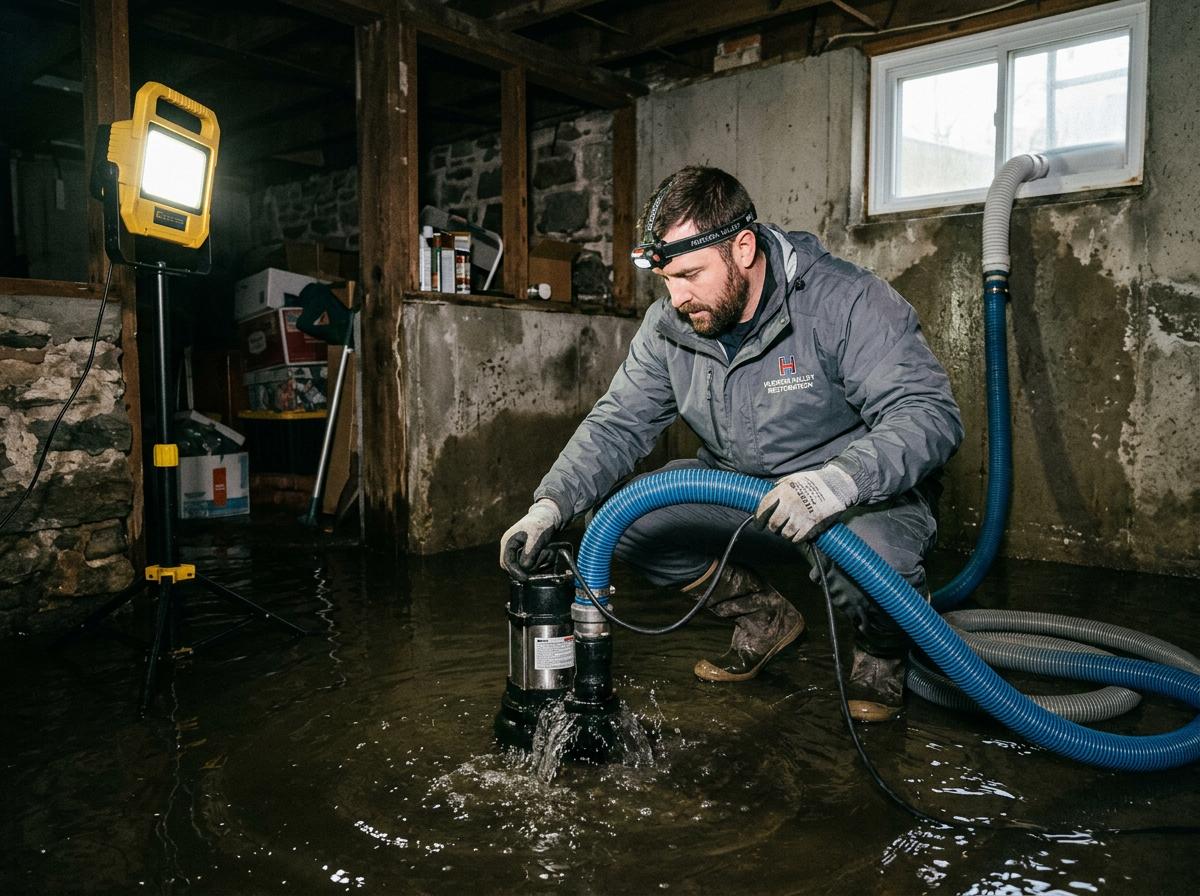
Nineteenth-century river-slope houses in Tarrytown and the surrounding valley sit on rubble and fieldstone foundations that were never intended to stay dry. When tidal surges push the Hudson or nor'easters knock out power, water finds every seam between stones and saturates the cellar floor. Finished basements with carpet, drywall, and stored belongings turn Category 2 within two days if extraction is delayed, because the stone walls continue to weep long after the visible puddle is gone.
Sump-pump failure is the most common trigger here. When the pump loses power during a January storm, water rises from the floor drain and the base of the foundation at once. Crews start with submersible pumps and wet vacs to drop the level, then place air movers and dehumidifiers against the stone walls so moisture does not wick upward into first-floor framing. Finished spaces require selective demolition; insulation and lower sections of drywall are usually removed because they trap water against the cold stone.
Basement Water Removal Near You — Choose Your City
Every city below has its own local Basement Water Removal page with coverage details.
Westchester County
Rockland County
Westchester
Rockland
Dutchess
Dutchess County
Putnam
Orange
Putnam County
Moisture meters and infrared scans guide every decision. Stone cellars rarely dry completely without direct airflow to the wall face, and any remaining dampness behind new finishes will cause mold within weeks. Homeowners often try to save carpet padding and boxed items stored on the floor; most of these materials are discarded because they hold water against the slab and cannot be dried fast enough in winter humidity. The work stops only when meter readings match those of unaffected stone.
Technician insight
In Tarrytown the thing that catches most people out with Basement Water Removal is how long fieldstone keeps weeping after the sump is fixed. Homeowners see the floor dry and think they are done, but the mortar joints stay damp for days unless you force air directly against the wall. Skip that step and any new finish fails within a month.
Nor'easter Sump Failure on Main Street
Power loss during a February storm allowed the sump to stop while the Hudson was already high. Water entered through the base of the fieldstone and rose six inches across the finished rec room. Crews pumped the slab, removed the lower four feet of drywall and carpet, then ran air movers against the stone for four days until meters read within two points of unaffected areas. The homeowner was able to keep the upper drywall and joists.
Basement Water Removal Services We Offer
✓Sump Pump Failure Response
Rapid pumping and water extraction after power loss or mechanical failure during Hudson Valley storms.
✓Finished Basement Restoration
Selective removal of wet drywall, carpet, and insulation followed by drying of fieldstone walls and slab.
✓Fieldstone Foundation Drying
Air-mover and dehumidifier placement against rubble walls to pull moisture from mortar joints and prevent wicking.
✓Crawl Space Water Removal
Extraction and drying beneath older Tarrytown homes where standing water threatens joists and insulation.
✓Moisture Mapping and Verification
Meter and infrared documentation of hidden dampness in stone cellars before any wall or floor repairs begin.
How it works
- 1
Initial Assessment
Technician inspects the cellar, identifies water source, and checks for hidden saturation in fieldstone and finished surfaces.
- 2
Water Extraction
Submersible pumps and wet vacs remove standing water from the slab and behind foundation stones.
- 3
Drying Setup
Air movers and dehumidifiers are positioned against stone walls and under finished areas; moisture is tracked daily.
- 4
Verification and Hand-Off
Final meter readings confirm stone and slab are dry before any reconstruction or homeowner repairs.
Pricing
Every basement presents different stone conditions and finished-space variables, so scope and pricing are set only after inspection; call Hudson Valley Flood Response for a site visit.